




Risks and Prevention of Extracorporeal Blood Loss During Dialysis
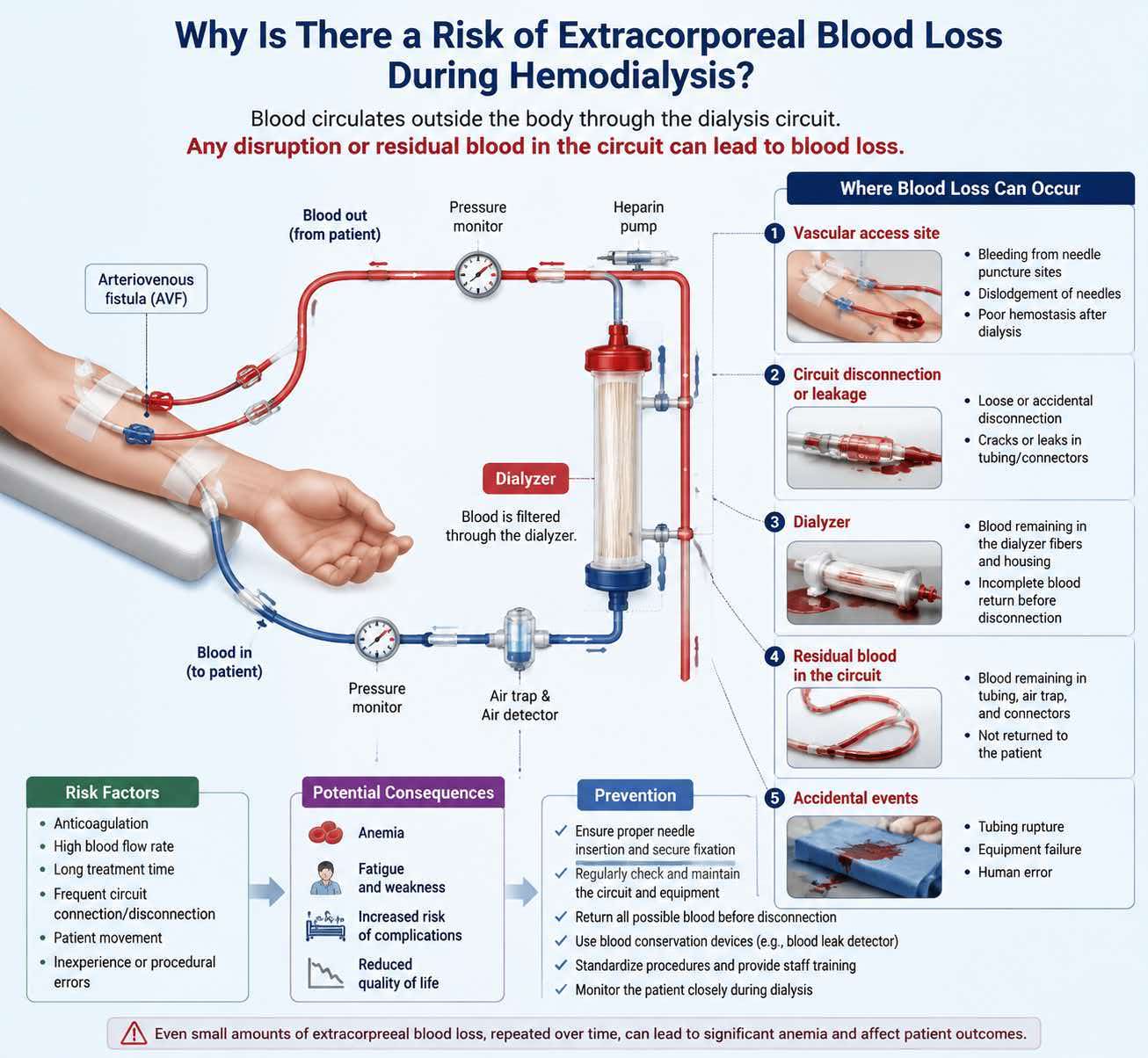
We see it all the time in dialysis—everyone focuses on the clearance rates and the fluid removal, but we often forget about the blood that’s sitting right there in the tubing. That’s a real risk, and it’s not small. For chronic kidney failure patients, most already have renal anemia, so even a little extra blood loss during treatment can push them over the edge. We’re talking about roughly 200 milliliters of blood cycling through the extracorporeal circuit every single session. And if a clot forms in the lines, or if the puncture site keeps oozing, or the needle accidentally pulls out, then that hemoglobin drops, fatigue and dizziness get worse, and we put extra strain on the heart. So the cardiovascular complications go up. And here’s the scary part: if we don’t catch a venous line disconnection in time, the patient can lose blood so fast that they slip into hypovolemic shock within minutes. That’s not a theory—that’s a known danger we have to face head-on.
We’ve looked at the clinical data, and the reasons boil down to a few repeat offenders. First, the circuit isn’t fully sealed—loose connections, faulty joints, you name it. Second, the puncture needle or the catheter can dislodge, especially if the patient moves around. Third, we see bleeding after we pull the needle, but only because the compression wasn’t done right. Then there’s the clotting issue: when we do heparin-free dialysis, or when the fistula needle draws poorly because of low flow, the blood stagnates and clots form. And don’t forget sloppy handling—like opening the dialysis lines at the wrong time, or puncture-site oozing that just won’t stop. But we also have to admit that patients themselves are a factor—if they shift too much in the chair, the needle tip can bump against the vessel wall, and that restricts flow, which triggers clotting too. So it’s a mix of equipment, technique, and patient behavior.
To address these risks, medical institutions and patients need to build a multi-layer protection system together.
On the management side, they must strengthen dialysis quality control, standardize every procedure, and spell out nursing routines for each step in detail.
On the technical side, they should use a fully closed priming and blood return method from start to finish, because that cuts infection risk and lowers oozing rates. And dialysis machines should be fitted with leak detectors and other alarm systems so that any problem gets spotted early.
On the operation side, nurses have to watch line pressures, blood color changes, and machine alarms very closely, and they act immediately if they see any sign of clotting. They also need to fix the puncture needles firmly and tell the patients not to pull or tug on the blood lines during the treatment.
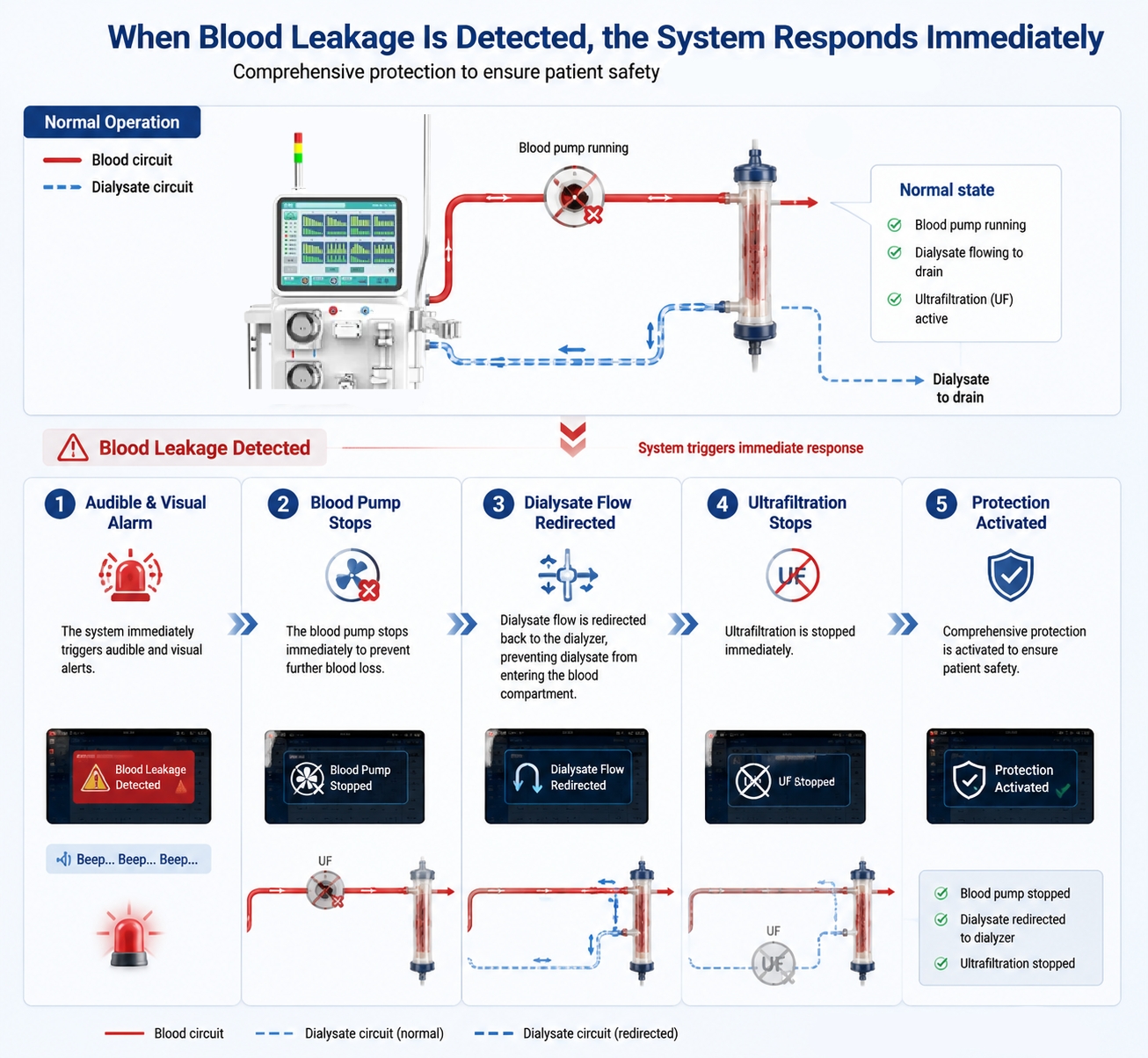
Now let’s talk about the machine itself – it has a leak protection system that does a solid job.
Under the maximum dialysate flow, ultrafiltration rate, and replacement fluid rate (only for the W T6008S model), the maximum alarm limit for leakage rate is ≤0.35 mL/min (with blood HCT at 32%). And when a leak is detected, the device doesn’t just sit there – it gives both a light alarm and a sound alarm, stops the blood pump right away, and blocks the dialysate from going to the dialyzer (or filter). For the W T6008S, it also stops the replacement fluid from entering the blood, and it halts ultrafiltration too. So this system buys the clinical team extra time to step in, and that is a real safety plus.
Only when risk awareness runs through every single link can the risk of extracorporeal blood loss be brought down to the lowest level, and then dialysis treatment becomes safer and more reassuring for everyone.
Post time: Aug-24-2026


